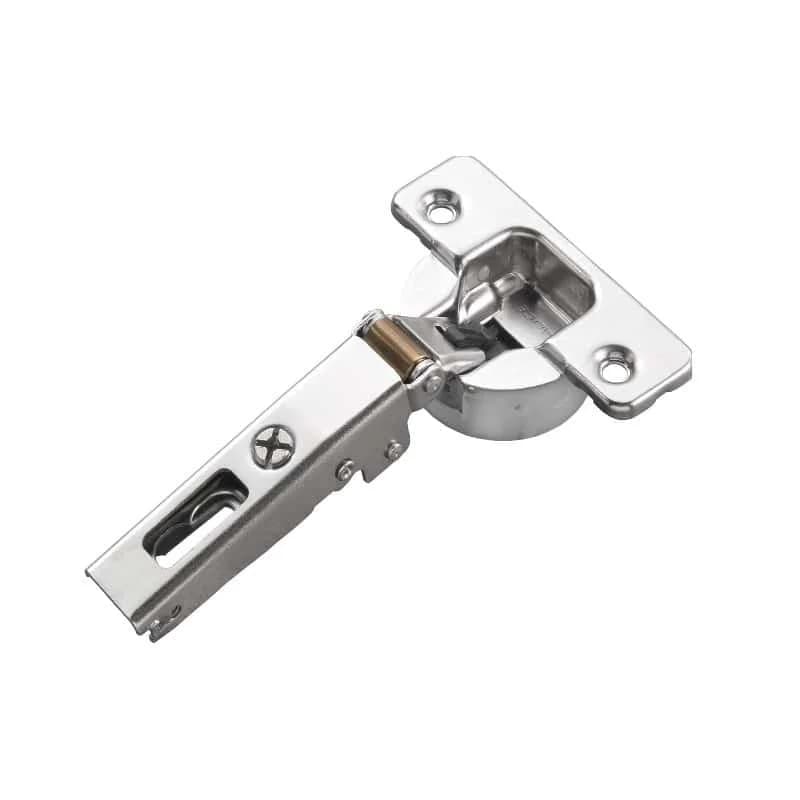
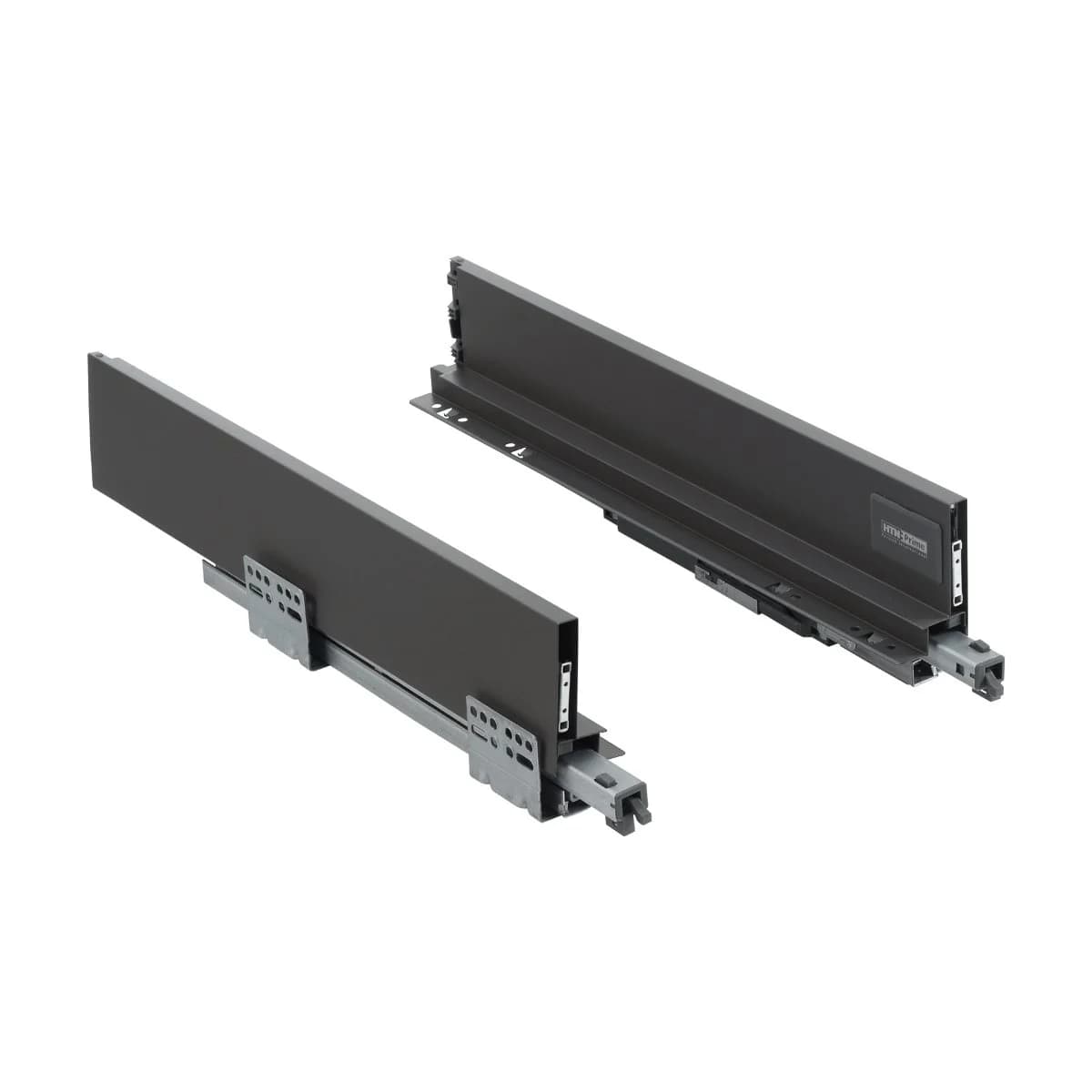
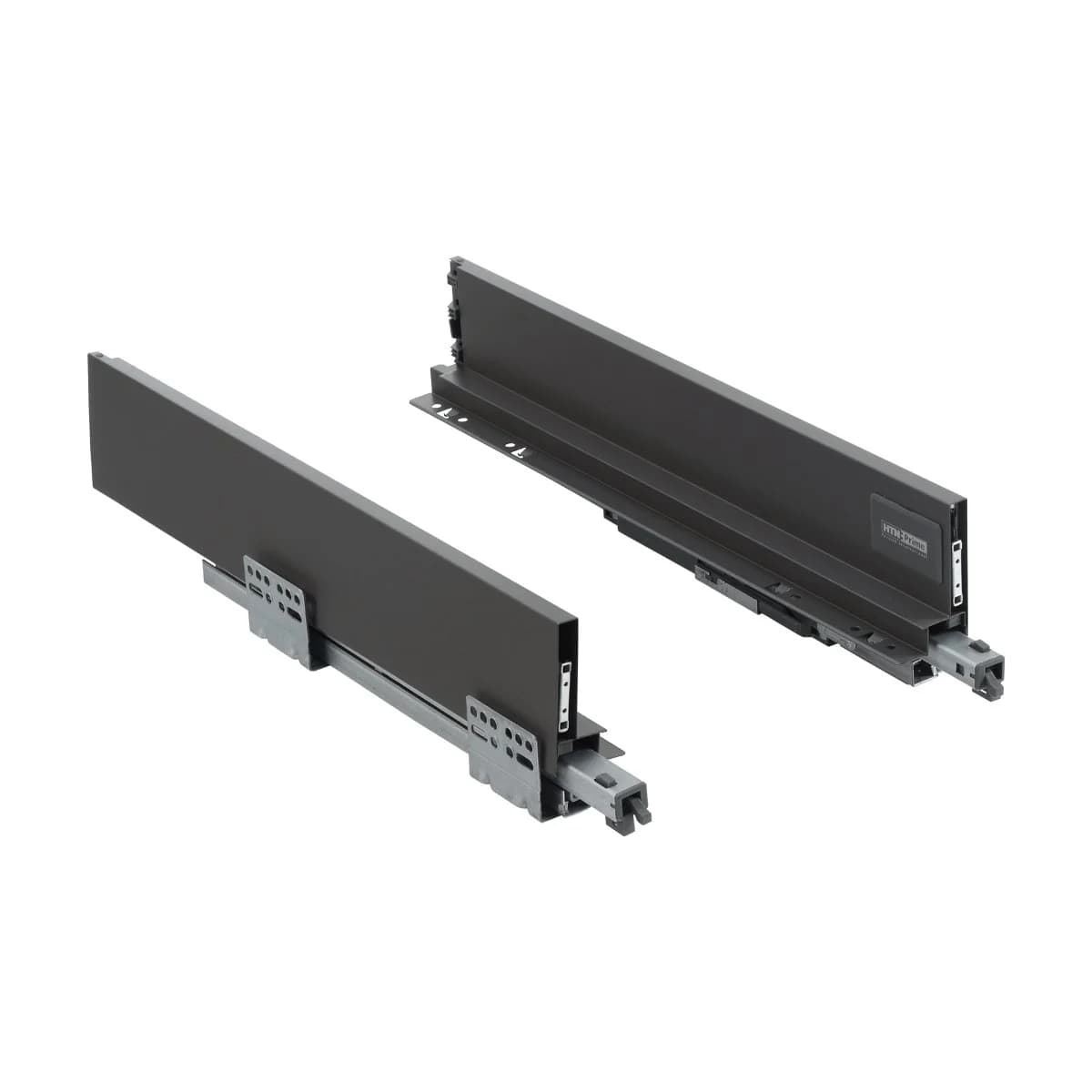
Cabinet Hinge Overlay Guide: Full Overlay vs Half Overlay vs Inset Explained
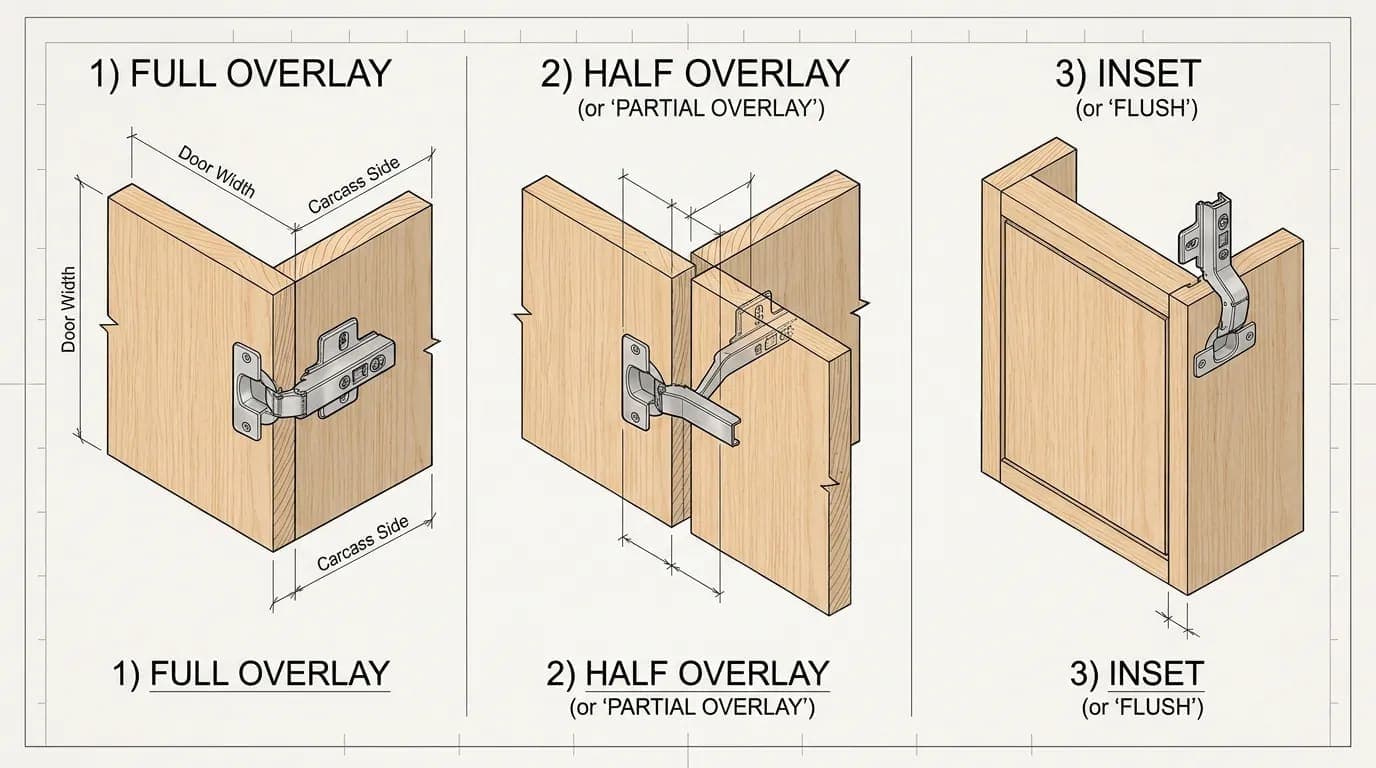
Hinge Overlay Visual Selector Guide
Instantly identify whether your cabinet requires Full Overlay, Half Overlay, or Inset.
Full Overlay (Straight Arm — 0mm Crank)
The door fully overlaps the front edge of the cabinet side panel (16–19 mm), leaving only a minimal 1–2 mm reveal. Standard for single cabinet doors and freestanding wardrobe carcasses.
Select when the door should completely conceal the cabinet frame from the front view.
When planning cabinetry, specifying kitchen hardware, or replacing failing door hinges, carpenters and homeowners frequently encounter the three foundational European hinge configurations: Full Overlay, Half Overlay, and Inset. Specifying the wrong hinge geometry inevitably leads to door interference, incomplete closure, or unsightly gaps. The governing principle behind all three is known as Hinge Overlay.
Core Selection Rule: "Overlay" defines how much of the cabinet side wall (carcass partition) the closed door covers. If the door conceals the entire cabinet side, select Full Overlay. If two adjoining doors share a single divider panel, select Half Overlay. If the door nests completely inside the carcass frame, select Inset.Understanding Overlay and Crank Height
Modern European concealed hinges control door positioning via precisely calibrated arm geometry known as Crank Height. This factory-stamped bend in the hinge arm dictates where the closed door rests relative to the cabinet frame:
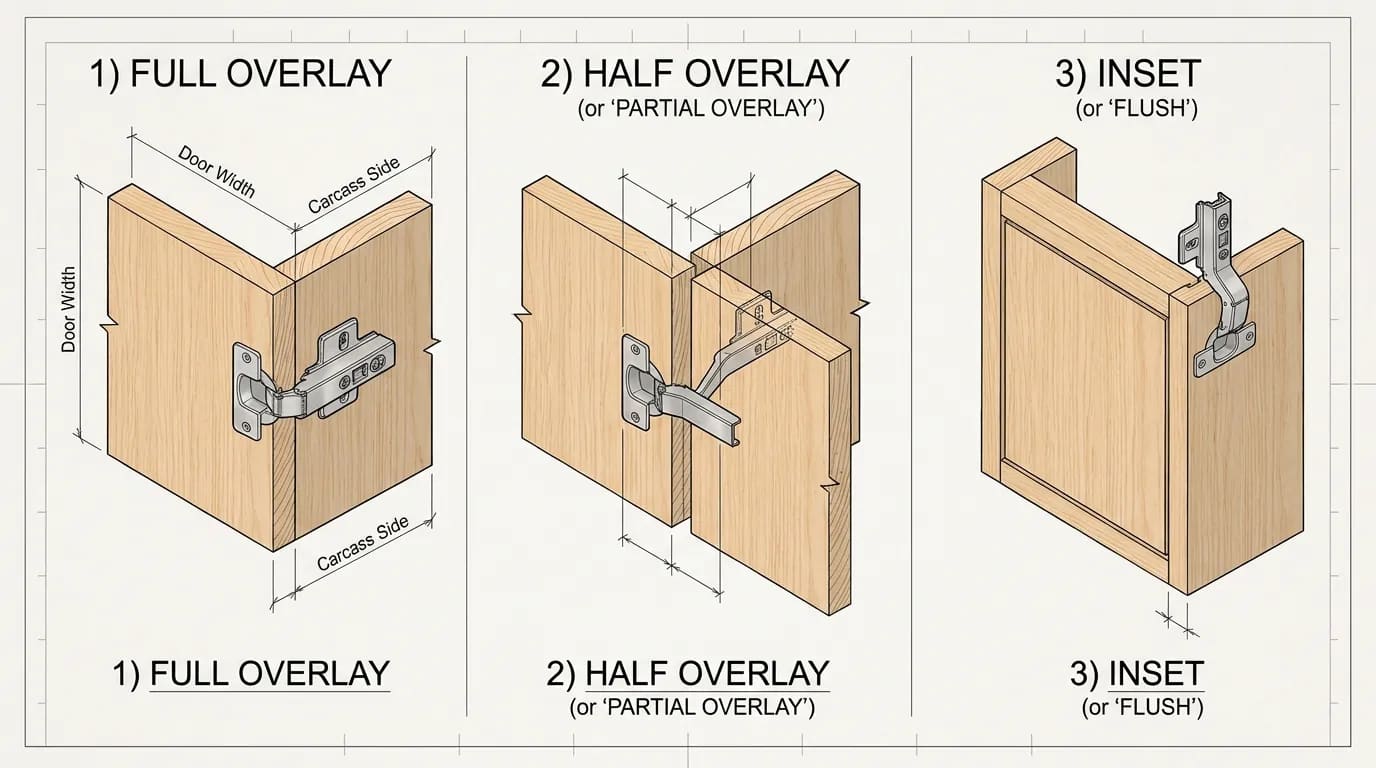
1. Full Overlay (Straight Arm — 0mm Crank)
The Full Overlay hinge represents the universal standard in contemporary residential and commercial cabinetry, accounting for over 85% of all installed concealed hinges. In this configuration, the articulated arm is completely flat and straight (Crank Height = 0mm).
- Carcass Coverage: The door overlaps the entire front edge of the cabinet side panel (16mm to 19mm), leaving only a minimal 1–2mm outer expansion reveal.
- Architectural Aesthetic: The wooden cabinet box is completely concealed from the front, producing clean, seamless monolithic runs of cabinetry.
- Applications: Single cabinet doors, standalone storage boxes, end-of-run carcass units, and modern handleless modular kitchens.
2. Half Overlay (Cranked Arm — 9mm Crank)
A Half Overlay hinge incorporates a distinct 8mm to 9mm crank (bend) in the center of the hinge arm. This mechanical geometry was engineered specifically to resolve the challenge of the Shared Middle Partition.
- Carcass Coverage: When two opposing cabinet doors meet on a single central upright divider (standard 18mm board), installing two straight hinges would cause the doors to collide. The Half Overlay hinge offsets the door so each panel covers exactly half the partition thickness (8mm to 9mm per door).
- Reveal Gap: A 2mm to 3mm clearance gap remains between the two doors, allowing either door to swing open to 105°–110° independently without binding against the adjacent door edge.
- Applications: Multi-door wardrobes, side-by-side kitchen cupboards, and large larder cabinets featuring shared vertical carcass dividers.
3. Inset / Flush (High Crank — 18mm Crank)
Inset hinges feature the most pronounced arm offset, with a high crank bend of 16mm to 18mm. Unlike overlay configurations, Inset doors do not cover any portion of the cabinet carcass front edge.
- Carcass Coverage: Zero millimeters (0mm overlay). The door is recessed entirely inside the cabinet box opening, sitting flush with the outer front edge of the carcass frame.
- Architectural Aesthetic: The exposed wooden cabinet perimeter surrounds the door like a framed picture. This demanding aesthetic represents premium craftsmanship and luxury bespoke joinery, requiring precise reveal tolerances.
- Applications: Flush minimalist architectural millwork, glass display cases, and traditional bespoke face-frame furniture.
Comprehensive Hinge Comparison Matrix
| Specification | Full Overlay | Half Overlay | Inset / Flush |
|---|---|---|---|
| Arm Crank Height | 0 mm (Completely straight) | 9 mm (Medium crank) | 18 mm (High crank) |
| Carcass Overlap | 16 – 19 mm (Full side edge) | 8 – 9 mm (Half side edge) | 0 mm (Recessed inside opening) |
| Closed Door Stance | In front of carcass face | In front of half carcass face | Flush inside cabinet opening |
| Clearance Reveal | 1 – 2 mm outer reveal | 2 – 3 mm between dual doors | 2 mm reveal around entire perimeter |
| Market Adoption | ~85% of residential cabinets | ~12% (Multi-door runs) | ~3% (High-end architectural) |
| Matching Morfix Model | MFX-0006 / MFX-0004 | MFX-0007 | MFX-0009 |
Drilling Parameters and Engineering Standards
All certified European concealed hinges supplied by Morfix conform to standard DIN EN manufacturing specifications:
- Cup Boring Diameter: Standard 35mm circular recess drilled on the back of the door.
- Cup Boring Depth: 11.5mm to 12.5mm (compatible with 16mm–22mm door thicknesses).
- Boring Distance K (Edge Margin): Distance from the door edge to the cup hole perimeter (typically 3mm to 7mm; 4mm–5mm is optimal).
- Screw Hole Center-to-Center: 45mm or 48mm pattern.
Formula for Calculating Final Overlay
To compute the precise resulting overlay ($D$) and ensure zero edge binding:
D = K + H - SWhere:
- D (Resulting Overlay): The actual overlap distance over the cabinet edge.
- K (Boring Margin): Edge-to-cup boring distance (typically 4mm).
- H (Mounting Plate Height): Baseplate thickness (0mm, 2mm, or 4mm).
- S (Crank Deduction): Hinge arm crank offset (0mm for Full Overlay, 9mm for Half Overlay, 18mm for Inset).
Top 4 Cabinet Hinge Installation Pitfalls to Avoid
- Mounting Full Overlay Hinges on Shared Divider Walls: Leads directly to door collision upon simultaneous closure. Always install Half Overlay hinges (MFX-0007) when two doors share one upright.
- Neglecting Inset Depth Alignment: If an Inset door catches on the cabinet frame during opening, turn the horizontal depth cam screw half a turn counterclockwise to project the door 1–2mm outward.
- Over-Drilling Cup Holes: Boring deeper than 13mm into an 18mm decorative panel risks blistering the external veneer. Always use a dedicated Forstner bit with a calibrated depth collar.
- Relying on Non-Adjustable Hinges: Budget hinges lack integrated 3D spiral cam screws, leaving you unable to correct door sag over seasonal humidity cycles. All Morfix hinges feature full 3-axis 6-way alignment.