Soft Close Cabinet Hinges: Types, How They Work, and 3D Adjustment Guide
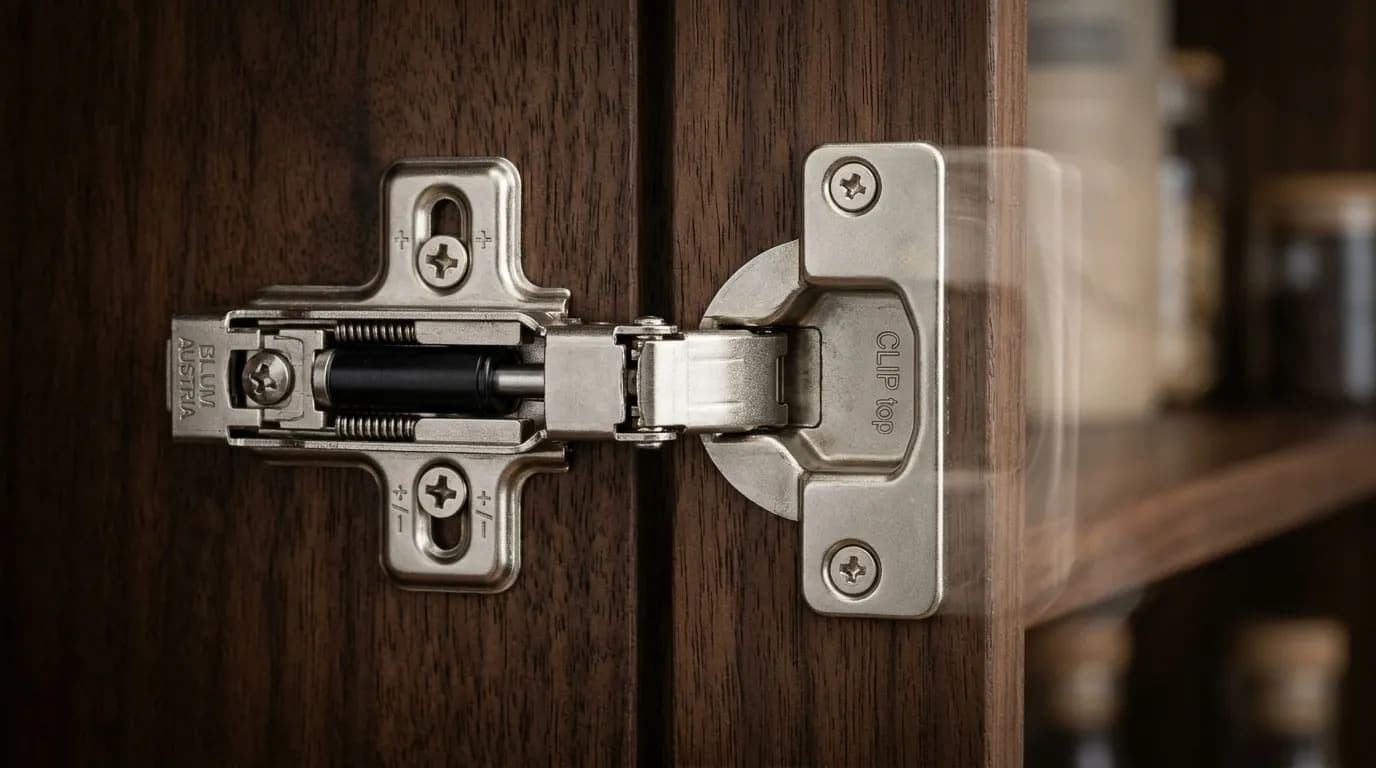
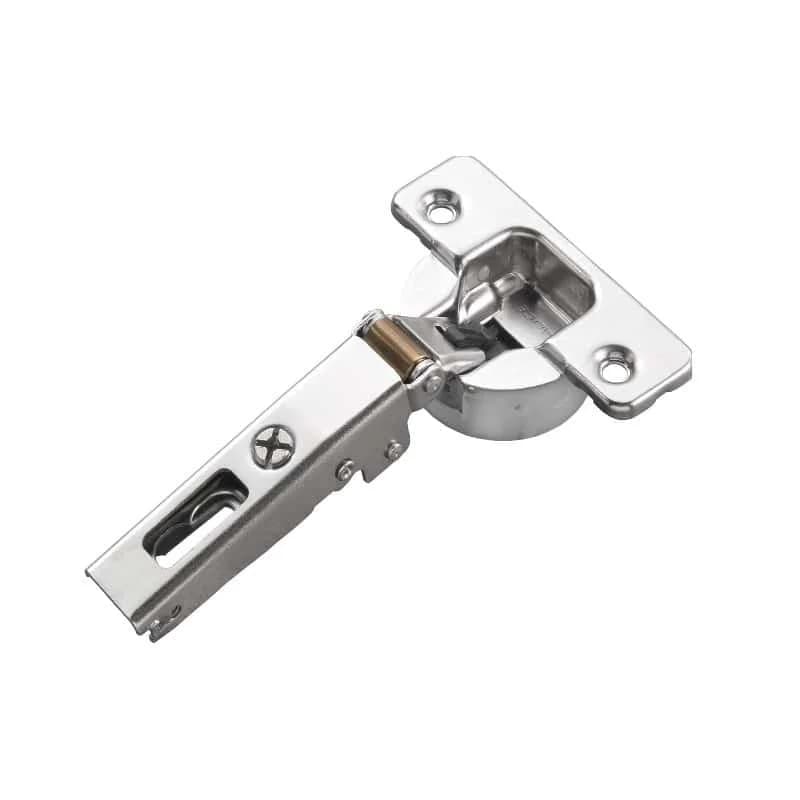
Concealed soft-close cabinet hinges are precision-engineered door hinges equipped with an integrated hydraulic damper. In the final 2 to 3 inches of swing, the damper absorbs kinetic energy, easing the cabinet door shut silently without bounce or vibration. Concealed entirely within the cabinet carcass, they offer 6-way (3D) adjustability to align doors along lateral, depth, and vertical planes.
Key Takeaway: Beyond eliminating noise, soft-close dampers protect the integrity of the cabinet carcass. By neutralizing repeated mechanical slamming, they prevent screw fatigue, joint loosening, and hinge plate pull-out over decades of heavy daily use.How Soft-Close Dampers Work
Standard European concealed hinges rely solely on a mechanical spring to snap the door shut or keep it open. A soft-close hinge integrates a miniature, precision-machined hydraulic cylinder inside the articulated hinge arm. As the door closes, an internal piston compresses specialized silicone dampening oil through calibrated micro-orifices. The resulting fluid resistance increases proportionally to the door's momentum, providing a controlled deceleration that brings the door to a whisper-quiet rest against the cabinet face.
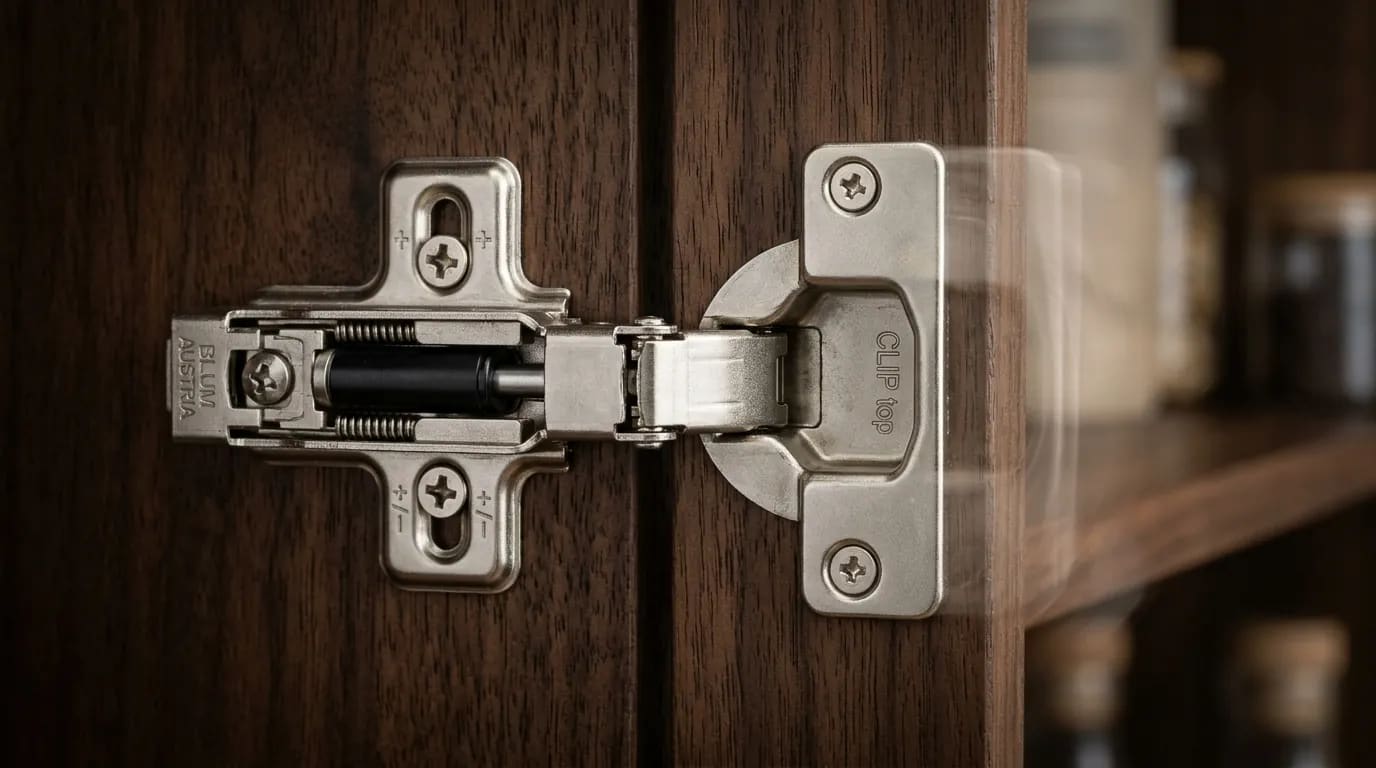
The Anatomy of a 3D Soft-Close Hinge
Modern architectural concealed hinges comprise several precision-manufactured parts. Understanding these components is essential for correct specification and smooth troubleshooting:
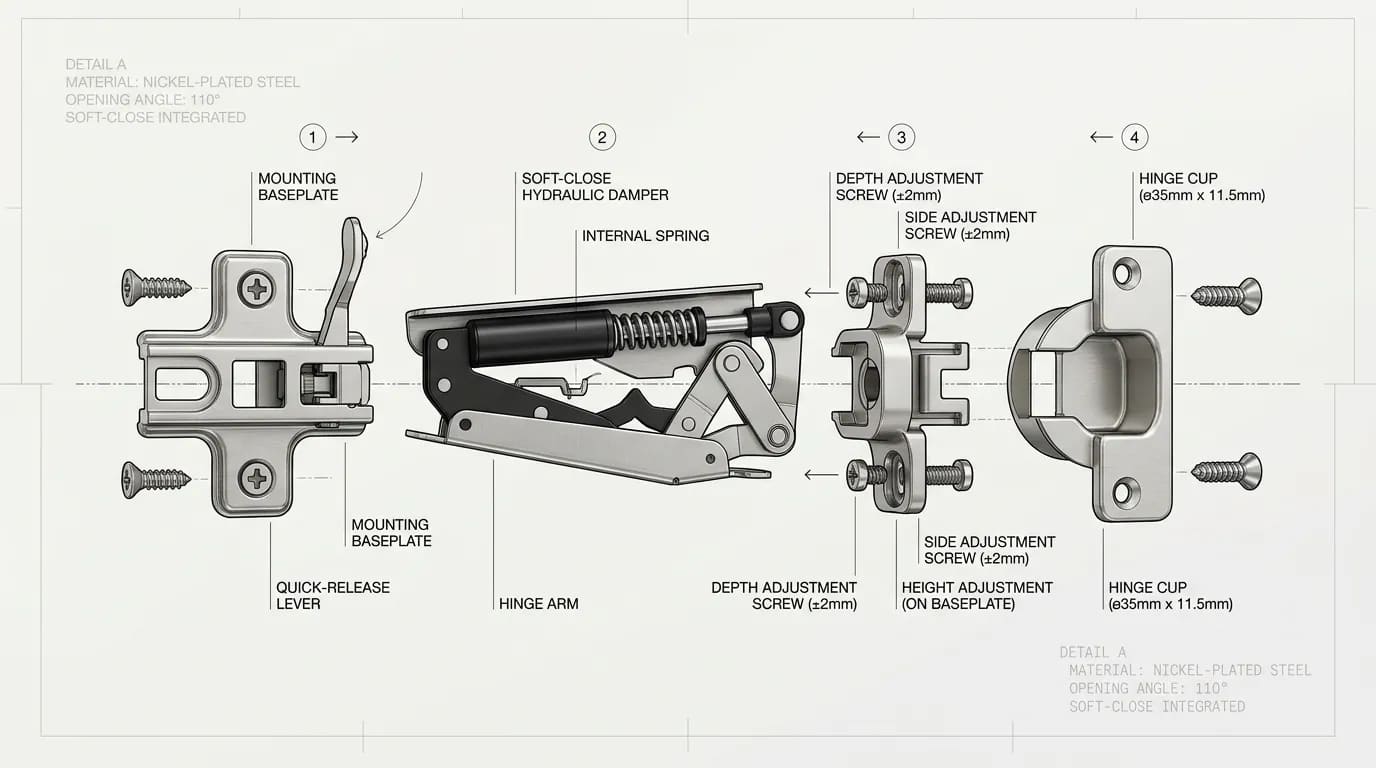
| Component | Engineering Function | Technical Specification |
|---|---|---|
| Hinge Cup (Boss) | Circular barrel pressed into a bored hole in the back of the door. Secures the door to the articulation linkage. | Industry standard 35mm diameter, 11.5mm–12.5mm boring depth, 45mm/48mm screw pattern. |
| Articulated Hinge Arm | Multi-pivot steel linkage connecting the cup to the cabinet mounting plate. Houses adjustment cams. | Available in Straight (0mm), Cranked (8-9mm), or High-Crank (16-18mm) geometries. |
| Hydraulic Damper | Sealed cylinder filled with high-viscosity silicone oil. Cushions final travel. | Tested to 80,000–100,000 operational cycles under DIN EN 15570 Grade 3 standards. |
| Clip-on Mounting Plate | Baseplate fastened directly to the cabinet wall. Allows tool-free snap-on door installation. | Cross-shaped or linear baseplates in 0mm, 2mm, or 4mm heights with vertical height adjustment slots. |
| 3D Cam Screws | Integrated spiral cam and slotted screws for independent 3-axis alignment. | Allows ±2mm lateral (side-to-side), ±2mm depth (in/out), and ±2mm vertical (height) fine-tuning. |
| Tension Switch | Mechanical selector switch on premium hinges to alter dampening force. | Allows deactivation of one damper on lightweight or narrow doors to prevent incomplete closure. |
Overlay Configurations: Full, Half, and Inset
Overlay defines how far the closed cabinet door laps over the carcass frame or side panel. Selecting the wrong overlay is the number one cause of misaligned doors that cannot be corrected by adjustment screws.
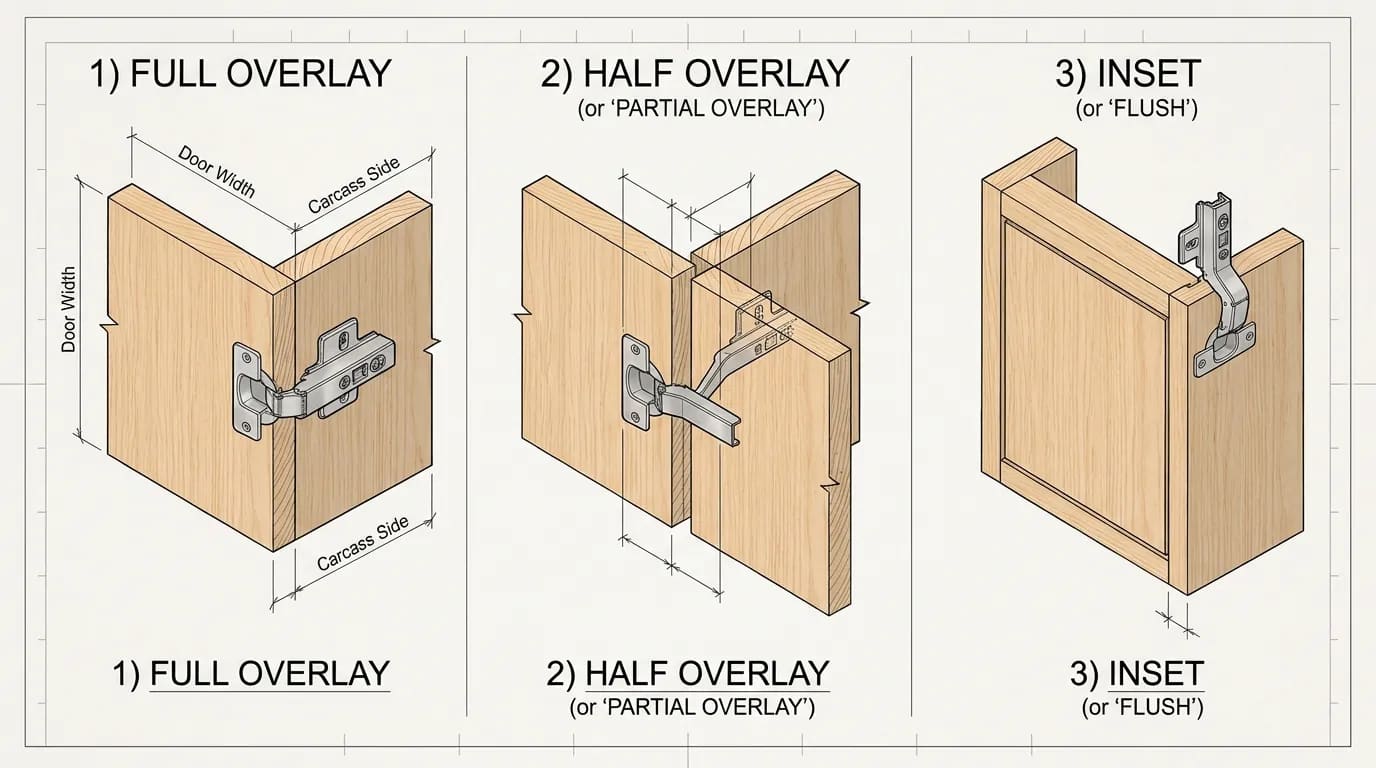
- 1. Full Overlay (Straight Arm / 0 Crank): The door completely conceals the edge of the cabinet side wall, leaving a minimal reveal (typically 1.5mm to 3mm). Standard for exterior side panels in contemporary frameless kitchens.
- 2. Half Overlay (Cranked Arm / 8–9mm Crank): Used when two adjacent cabinet doors hinge off a single shared central partition (16mm or 18mm board). Each door covers half the partition thickness without colliding upon opening.
- 3. Inset / Flush (High-Crank Arm / 16–18mm Crank): The door sits entirely recessed inside the cabinet carcass opening, flush with the outer front edge. Requires an inset-specific hinge plate and careful gap clearance.
- 4. Specialty Angles (Corner & Wide-Angle): For L-shaped corner cabinets with bi-fold doors, a 135° Pie-Cut Hinge connects door to door. For base units housing interior pull-out tandem drawers, a 155°–165° Zero-Protrusion Hinge swings the door completely clear of the interior opening.
5-Step Selection Checklist for Projects & Workshops
- Check Cup Diameter: Standard full-size architectural doors require a 35mm diameter cup. Mini 26mm cups are reserved for delicate glass-frame or ultra-thin 12mm doors.
- Determine Overlay: Measure carcass side thickness (typically 16mm or 18mm) and calculate required door lap.
- Calculate Hinge Count per Door: Use the engineering load chart below to prevent door sagging:
- Doors up to 900mm height (under 5 kg): 2 hinges
- Doors 900mm to 1,600mm height (5–10 kg): 3 hinges
- Doors 1,600mm to 2,000mm height (10–15 kg): 4 hinges
- Doors 2,000mm to 2,400mm height (15–22 kg): 5 hinges
- Select Baseplate Mounting Type: Choose European frameless plates (32mm system hole spacing) or face-frame adapter brackets depending on cabinet construction.
- Verify Cycle Rating: Ensure testing to a minimum of 80,000 continuous cycles for residential kitchens and 100,000 cycles for high-traffic commercial installations.
How to Adjust Soft-Close Hinges (6-Way / 3D Alignment)
Modern 3D hinges allow tool-based adjustment across 3 separate axes. Always adjust in quarter-turn increments and check door reveals after every movement:
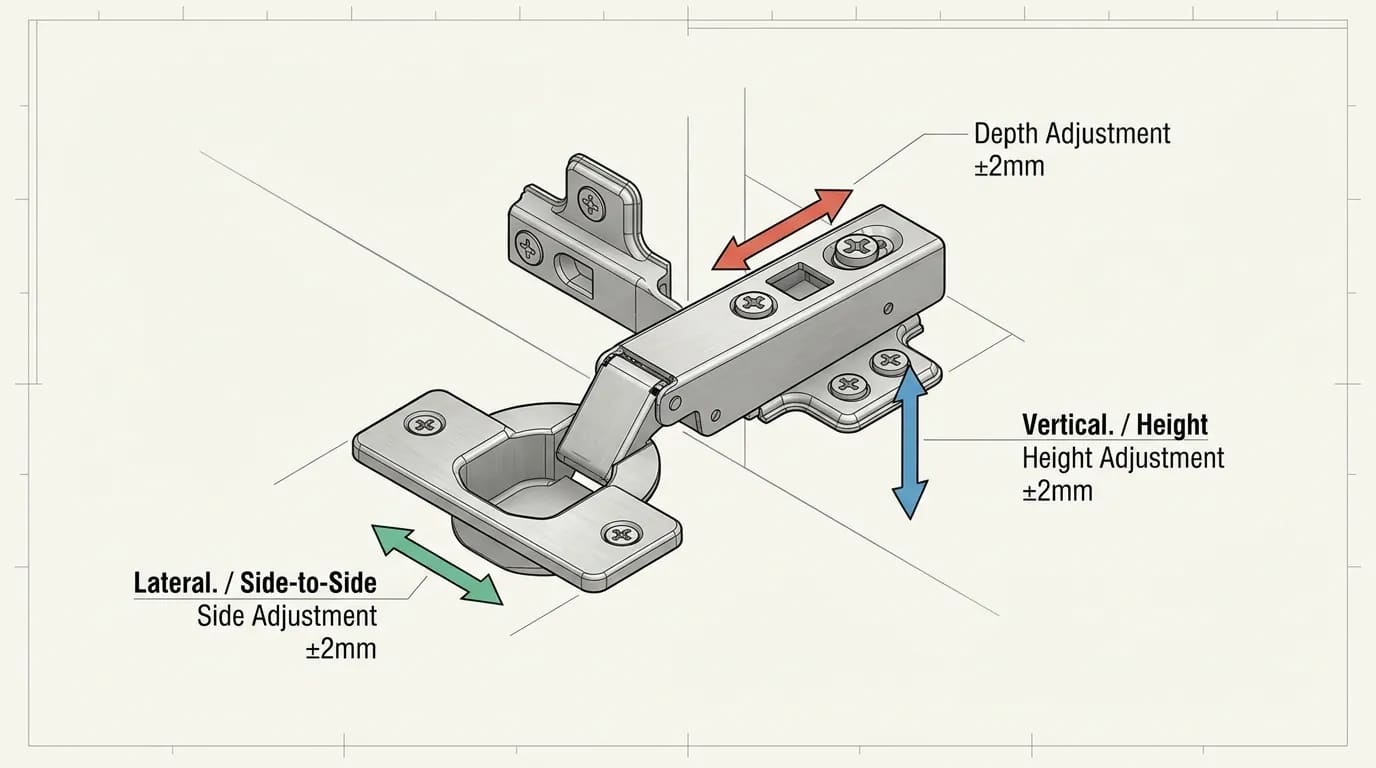
- 1. Lateral / Side-to-Side Adjustment (Front Cam Screw): Turning the screw closest to the door moves the panel horizontally left or right by ±2mm. Use this first to balance the vertical gap between twin doors.
- 2. Depth / In-and-Out Adjustment (Rear Spiral Screw): Turning or loosening the rear screw shifts the door toward or away from the cabinet box by ±2mm. This eliminates door rubbing against carcass edges and corrects minor panel warping.
- 3. Vertical / Height Adjustment (Mounting Baseplate Screws): Loosening the mounting screws in the slotted baseplate allows vertical adjustment of ±2mm. Realigns door tops across a continuous run of cabinets.
Troubleshooting & Diagnostics Matrix
| Symptom | Underlying Mechanical Cause | Targeted Solution |
|---|---|---|
| Door will not close completely (stops short) | Dampening resistance exceeds door weight, or tension switch is engaged on both hinges for a light door. | Switch off the damper on one hinge using the tension selector lever, or adjust depth screw outward. |
| Door slams shut with noise | Hydraulic damper seal has failed, or door weight exceeds rated hinge capacity. | Inspect damper for oil leakage; replace defective hinge or install an additional center hinge for heavy doors. |
| Door sags at outer corner | Mounting plate screws loose in particle board / MDF, or hinge count insufficient for door height. | Tighten baseplate screws with wooden dowel reinforcement if stripped; add a 3rd or 4th hinge. |
| Uneven gap between double doors | Lateral eccentric adjustment unbalanced. | Turn front adjustment screws in quarter-turn increments on both doors until gap is uniform top to bottom. |
| Hinge arm pops off baseplate | Quick-release rear claw not fully engaged into baseplate locking bar. | Hook front hooks first, then press firmly on the rear of the hinge arm until an audible click confirms positive latching. |
Upgrading Existing Cabinets to Soft-Close
If your existing kitchen features standard 35mm concealed hinges without soft-close, upgrading is straightforward:
- Drop-in 3D Soft-Close Hinge Replacement (Recommended): Unclip the old hinges, verify cup diameter (35mm) and overlay (Full, Half, or Inset), and install new Morfix 3D soft-close hinges directly into the existing boring pattern. Takes under 5 minutes per door.
- Add-on Hydraulic Dampers: For vintage cabinets or specialized hardware, clip-on piston dampers can be installed on the top cabinet corner to cushion standard hinges without replacement.
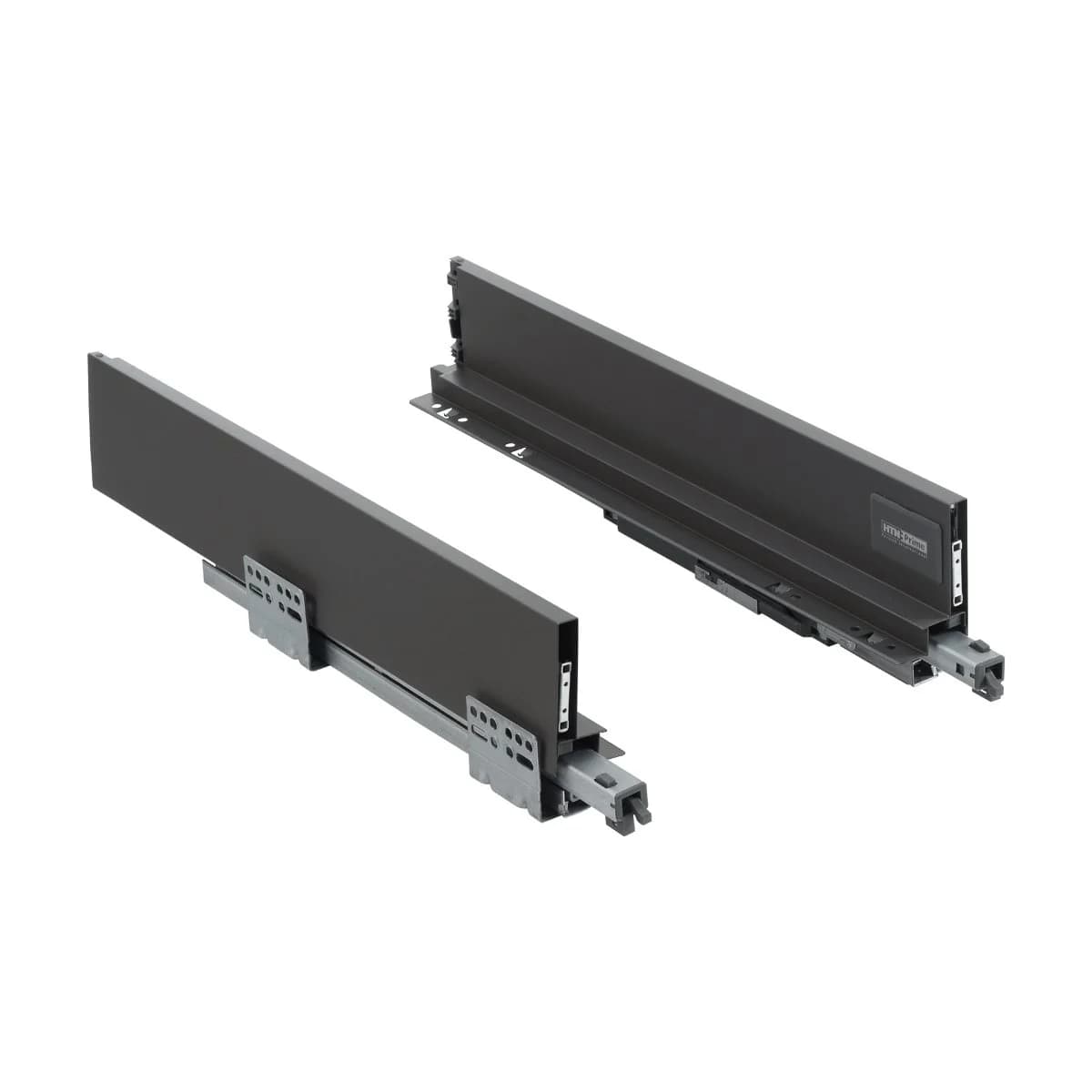
Synergy: Complete the Quiet Kitchen with Tandem Drawer Runners
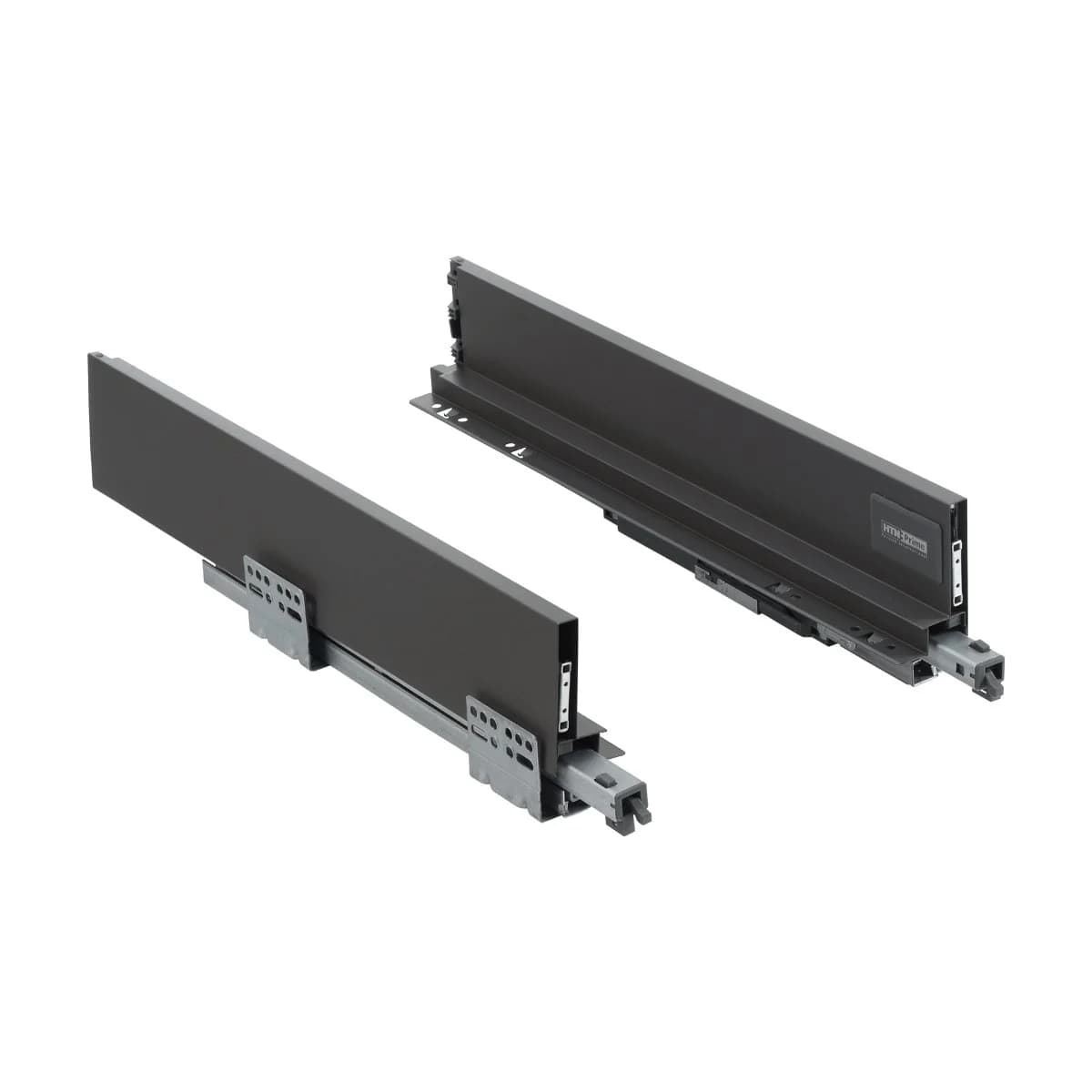
Soft-close doors should always be paired with synchronized undermount drawer slides (Tandem Box runners). Outfitting doors with whisper-quiet hinges while leaving drawers to bang creates an unbalanced user experience. High-end modern kitchens utilize concealed undermount runners with integrated fluid dampers, rated for 35kg to 50kg dynamic loads.
Looking for Certified Architectural Hardware?
Explore Morfix's full line of 3D adjustable soft-close concealed hinges, tandem drawer runners, and kitchen fittings engineered for architects, custom millwork studios, and professional furniture manufacturers.
FAQ
هل المفصلات الهيدروليك السوفت كلوز تستحق التكلفة الإضافية؟
نعم بكل تأكيد؛ فبالإضافة للهدوء التام ومنع الضوضاء في المنزل، يمنع البستم الهيدروليكي ارتطام الدرف المستمر، مما يحمي مفاصل الأخشاب والشاسيه ومسامير التثبيت من التلف ويزيد من العمر الافتراضي للمطبخ لسنوات طويلة.
هل يمكنني تحويل مطبخي القديم إلى سوفت كلوز بدون تغيير الدرف؟
نعم، طالما أن درفك الحالية تستخدم مفصلات مخفية قياسية بقطر كوب 35 مم، يمكنك فك المفصلات القديمة وتركيب مفصلات سوفت كلوز 3D بنفس مقاس الكوب والتراكب (عدلة أو نص ركبة) مباشرة في نفس الفتحات دون أي تعديل بالخشب.
ما الفرق بين مفصلات السيلف كلوز (Self Close) والسوفت كلوز (Soft Close)؟
مفصلات الـ Self-Close تعتمد على سوستة تشد الباب للإغلاق في آخر زاوية لكنها تتسبب في اصطدام الباب بالشاسيه وإحداث صوت، أما مفصلات الـ Soft-Close فتحتوي على بستم زيت هيدروليكي يفرمل حركة الباب ويهدئها لتغلق بنعومة وصمت تام.
لماذا ترتد الدرفة أو تصطدم رغم وجود مفصلة هيدروليك؟
يحدث ذلك عادة بسبب تلف بستم الزيت الداخلي وانتهاء عمره الافتراضي، أو لأن وزن الدرفة أكبر بكثير من عزم المفصلتين فتحتاج إلى مفصلة ثالثة، أو نتيجة وجود مفصلة عادية مختلطة مع مفصلة هيدروليك في نفس الدرفة.
كم مفصلة تحتاجها درفة المطبخ أو الدولاب؟
القاعدة الهندسية المعتمدة: مفصلتان للدرف حتى ارتفاع 90 سم (أقل من 5 كجم)، 3 مفصلات للدرف من 90 إلى 160 سم (5-10 كجم)، 4 مفصلات للدرف من 160 إلى 200 سم (10-15 كجم)، و5 مفصلات للدواليب الطويلة حتى 240 سم.
كيف أضبط درفة المطبخ المائلة أو غير المتساوية مع جارتها؟
باستخدام مسامير الضبط ثلاثية الأبعاد: مسمار الكامة الأمامي يحرّك الدرفة يميناً ويساراً، المسمار الخلفي يضبط بروزها للداخل أو الخارج، وفك مسامير الشاسيه يسمح برفع أو خفض الدرفة رأسياً. اضبط بربع لفة واختبر الباب.